
Straight answers for parents
What 'Natural' Deodorant Really Means
What natural deodorant is, what it can and cannot do, how to switch without drama, and which stick to start with.
Shop Deodorant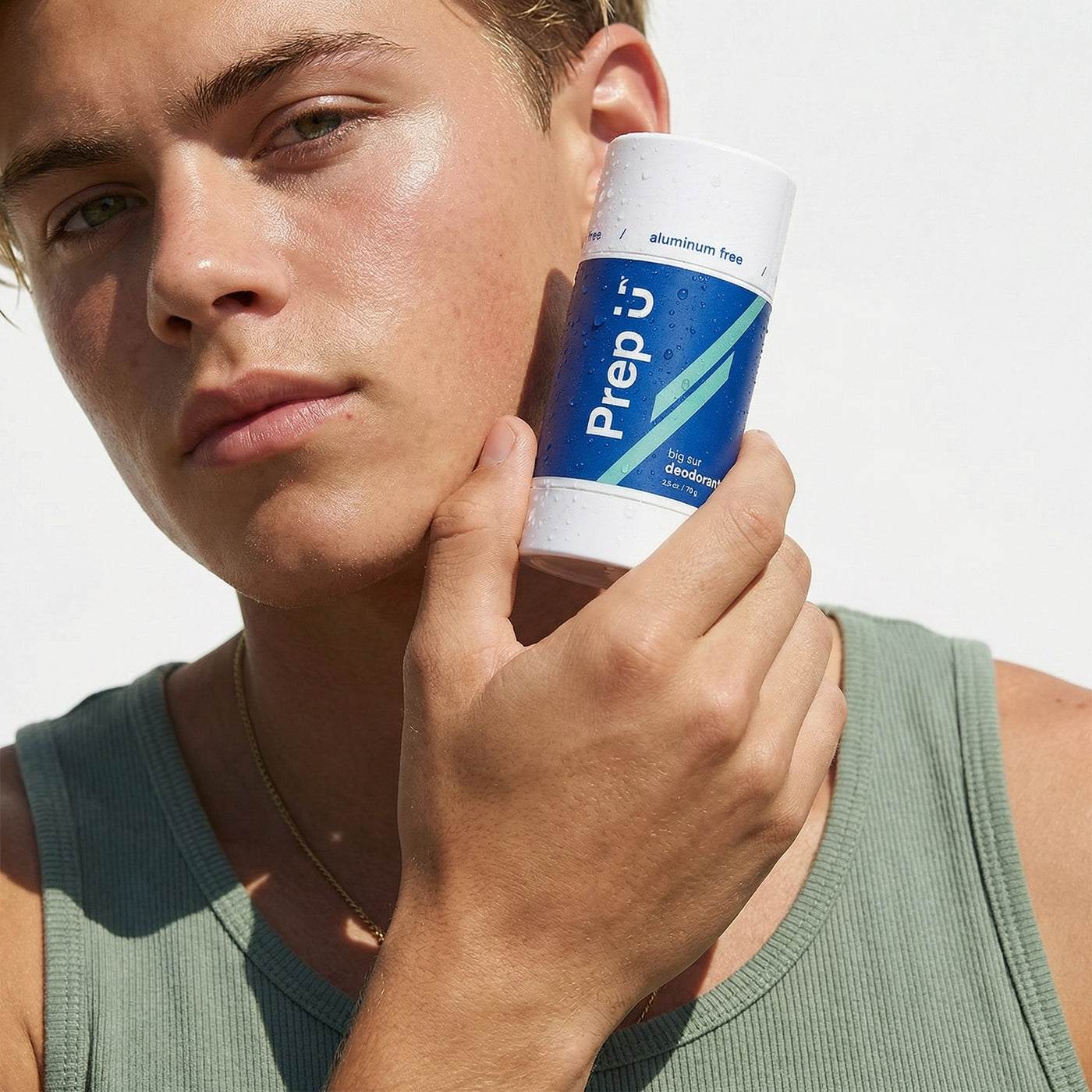
Natural Deodorant for Teens: A Parent’s Guide
Natural deodorant is an aluminum-free stick that handles odor with ingredients like magnesium hydroxide and plant waxes instead of blocking sweat. Prep U's version is built for teens, and this guide is for parents deciding whether to try one.
It covers what the word natural does and does not mean on a label, how deodorant differs from antiperspirant, what is in a typical stick, the baking soda question, what the first two weeks look like, and how to pick a first stick. No scare tactics, and no promise that any product suits every kid.
The Short Answer
- Natural deodorant is deodorant made without aluminum. It works on odor, not sweat, so sweating still happens.
- The word natural has no legal definition for cosmetics in the U.S., which makes the ingredient list the only reliable guide on the box.
- Baking soda is the ingredient most often blamed for irritation. Where it sits on the list tells you how much is in there.
- Give a new stick one to two weeks before you judge it, and stop if you see redness, burning or bumps.
- If your teen has sensitive skin or has reacted to fragrance before, start with an unscented stick and patch test first.
What does natural actually mean on a deodorant label?
Not much, legally. The FDA has not set a definition of natural for cosmetics, so the word on the front of a stick is a marketing choice and not a standard.
What parents usually mean by it is a short list of things left out: aluminum, parabens, sulfates and, for some families, synthetic fragrance. A good label shows a plain ingredient list in their place. Flip the stick over and look for waxes, butters, a mineral or two, maybe a scent blend. If you can name most of it, you are in the right neighborhood.
The ingredient list does the work that the front-of-box word only claims to.
What is the difference between deodorant and antiperspirant?
Deodorant deals with odor. Antiperspirant deals with sweat. In the U.S. the FDA treats antiperspirants as over-the-counter drugs and deodorants as cosmetics, which is why antiperspirant labels carry a Drug Facts box and deodorant labels do not.
Antiperspirants use aluminum salts that form a temporary plug in the sweat duct, so less sweat reaches the skin. A natural deodorant skips that step. Sweat still happens, which is normal, and the stick works on the odor that shows up afterward.
Sweat on its own has very little smell. The odor appears when skin bacteria break down the oils and sweat from the underarm glands that switch on at puberty, and that is the problem a deodorant is built to solve.
Does natural deodorant work?
For odor, yes, and odor is the job it is built for. It will not keep your teen dry, so a damp shirt after gym class is still a damp shirt. What it should do is keep them from smelling like it by third period.
How well it works depends on the formula and the person. Body chemistry varies a lot, and kids in the middle of puberty often see a big jump in both sweat and smell. Sticks built around magnesium hydroxide, a mineral that neutralizes odor, tend to hold up through a school day. Sticks that mostly rely on a little coconut oil and essential oil often just cover the smell.
The honest summary: it works well for most people, takes a few days to judge, and does not block sweat.
What is actually in a natural deodorant stick?
Most sticks share the same bones. A base of waxes and butters, such as beeswax, shea butter and coconut oil, so it glides on. A powder like arrowroot to take the damp edge off. And one or more odor ingredients, usually magnesium hydroxide, baking soda, zinc oxide or a mix.
Here is the Prep U Unscented stick in label order: arrowroot powder, virgin coconut oil, shea butter, hydrogenated castor oil, beeswax, jojoba oil, magnesium hydroxide, sodium bicarbonate (baking soda), zinc oxide and tocopherols (vitamin E). The scented sticks use the same base with a scent blend added.
If anyone in your family reacts to shea or coconut, check the list before you buy. On any brand, the first few ingredients tell you most of the story. For more on the mineral that leads our formula, see magnesium hydroxide in natural deodorant.
Why do so many parents look at aluminum-free sticks for teens?
Usually it starts with a label. A parent reads aluminum, parabens, sulfates and starts wondering what their kid puts on every morning. Others arrive after a rash, or because a teen asked for something that smells like a person and not like a body spray.
Aluminum-free does not mean risk-free, and we will not pretend it does. A short ingredient list is easier to understand, easier to patch test and easier to trace when something does not agree with skin, which is worth a lot at 7am on a school morning. For the longer comparison, our guide to aluminum-free vs regular deodorant lays out both sides.
Is baking soda in natural deodorant a problem?
Baking soda is the most common odor ingredient in natural deodorant, and the most common reason people stop using it. It is alkaline, around pH 9, while underarm skin sits closer to pH 5. Put that gap in a warm, covered fold that sweats all day and it can mean redness, itching or burning for some people.
Position on the list is the clue. Ingredients run from most to least, so baking soda near the top means a lot of it. Prep U sticks do contain baking soda, listed after magnesium hydroxide (eighth of ten in the Unscented stick), so it plays a supporting role.
If your teen already reacts to baking soda, our page on armpit rash from deodorant walks through how to sort out the cause.
What should you expect when your teen switches?
Give it one to two weeks before you judge. Some people notice a bit more odor at first after leaving an antiperspirant, and that usually settles as skin adjusts. Our switching guide covers those first weeks.
Redness, burning, bumps and itching do not count as adjusting. Those are a reason to stop and check the ingredient list, not to push through.
When does a teen actually need deodorant?
Most kids start needing it somewhere between ages 9 and 14, when the underarm glands wake up. The cue is usually smell and not a birthday: a sharp or sour odor after school, or a shirt that smells by lunch.
Our page on what age boys start wearing deodorant goes through the signs, and deodorant for kids covers ages 8 to 14. How you bring it up matters more than the exact age. Something like "everybody gets there, and this is just the next thing on the list" lands better than a lecture.
How do you put it on so it works?
Clean, fully dry skin. Two light swipes per underarm, not a thick coat, and a minute to set before getting dressed.
Timing matters more than people expect. Shave at night and apply in the morning, because deodorant over freshly shaved skin is the classic recipe for a sting. After a hard workout, wash first and then reapply. Stacking more stick on top of sweat does not help, and it can leave skin feeling coated.
Can natural deodorant irritate skin?
Yes, like any product that sits on skin. Natural does not mean it cannot cause a reaction. The usual suspects are baking soda, fragrance (including essential oils, which come from plants but are still fragrance) and applying right after shaving.
Mayo Clinic says contact dermatitis, the usual kind of reaction, typically fades within roughly two to four weeks once the trigger is avoided. Patch test first: a small amount on the inner forearm or one small underarm spot for several days. If a rash spreads, blisters, oozes or does not improve, call your pediatrician.
How do you choose between scented and unscented?
Scent is personal, and teens care about it more than parents expect. If your teen has reacted to fragrance before, or you are not sure, start with unscented. It has no fragrance of any kind and no essential oils, and it is rated SkinSAFE 100. Our page on unscented deodorant for sensitive skin explains what to look for.
If your teen wants a scent they will actually wear, Hunter (yuzu, sea salt and driftwood) is an easy first pick. Not sure which? Pick 3 lets you mix and match three sticks, so everyone in the house can try a few.
What makes Prep U deodorant different?
Prep U has been formulating for teen skin since 2017. Every deodorant stick is aluminum-free and paraben-free, and the fragrance in the scented ones is phthalate-free and IFRA-compliant. The formula is built around magnesium hydroxide, with baking soda listed after it.
These are deodorants and not antiperspirants, so they handle odor and leave sweat alone. We would rather say that plainly than promise a dry shirt. Beyond deodorant, Prep U also makes body wash, bar soap and face wash for teen skin.
Is natural deodorant only for teens?
No. Nothing about an aluminum-free stick is age-restricted. We make ours with teen skin in mind, and parents who want to leave antiperspirant behind can use the same stick.
If you want a narrower guide, pick the one closest to your situation: natural deodorant for boys, aluminum-free deodorant for teen girls, natural deodorant for kids, natural deodorant for teen athletes, clean natural deodorant or safe natural deodorant for boys.
Why Prep U
What Makes Prep U Different
Aluminum-Free, Paraben-Free
These are deodorants, not antiperspirants. No aluminum salts, no parabens, and nothing that blocks sweat.
Magnesium Hydroxide Leads
Magnesium hydroxide is listed ahead of baking soda in every stick, and it does most of the odor work.
Baking Soda, Listed After Magnesium
Yes, there is baking soda in Prep U deodorant. It sits eighth of ten ingredients in the Unscented stick.
A Fragrance-Free Option
The Unscented stick has no fragrance of any kind and no essential oils, for teens who react to scent.
Prep U Picks
Choose the Right Prep U Deodorant

Unscented Deodorant
No fragrance of any kind. An easy first stick.
- No fragrance and no essential oils
- Magnesium hydroxide first, baking soda listed after it
- Aluminum-free and paraben-free

Hunter Deodorant
Yuzu, sea salt and driftwood
- Yuzu, sea salt and driftwood scent
- Same mineral base as the Unscented stick
- Aluminum-free and paraben-free

Pick 3 Deodorants: Mix & Match
Let your teen try a few scents
- Choose any three sticks
- A low-pressure way to find a favorite
- Includes the Unscented stick if you want it
Frequently Asked Questions
What is natural deodorant?
Deodorant made without aluminum that controls odor with ingredients like magnesium hydroxide, baking soda, zinc oxide and plant waxes. "Natural" has no legal definition for cosmetics in the U.S., so the ingredient list matters more than the label.
Does natural deodorant work?
For odor, yes. For sweat, no, so skin still gets damp. Results depend on the formula and the person, and a few days is usually enough to judge.
Is natural deodorant safe for teens?
For most teens, yes, and a short ingredient list makes it easy to check. No product suits every skin, though. Patch test on the inner forearm first, and see a pediatrician if a rash spreads, blisters or does not improve.
Is natural deodorant better than regular deodorant?
Different, not automatically better. Natural versions leave out aluminum and often synthetic fragrance, which matters to many families, while conventional ones suit some people just fine. What counts is that the stick controls odor and your teen's skin tolerates it.
Does natural deodorant stop sweat?
No. Only antiperspirants, which use aluminum salts, reduce sweat. Your teen will still sweat during practice or on a hot day, and that is normal.
Does natural deodorant have aluminum?
No. Aluminum is the active ingredient in antiperspirants, and natural deodorants leave it out. Every Prep U stick is aluminum-free. Check the label on any other brand, since some products are sold as deodorant and antiperspirant together.
What age can a teen start using natural deodorant?
There is no set age. Most kids need deodorant somewhere between 9 and 14, and the sign is a sharp smell after school or sports. Prep U sticks are made for ages 8 and up.
Does Prep U deodorant contain baking soda?
Yes, listed after the magnesium hydroxide, and eighth of ten ingredients in the Unscented stick. If baking soda has bothered your teen before, patch test first.
Is Prep U deodorant an antiperspirant?
No. Prep U sticks are deodorants, so they handle odor and do not block sweat.
What is the best natural deodorant for sensitive skin?
Start with a fragrance-free stick and check where baking soda sits on the label. Prep U Unscented has no fragrance of any kind and no essential oils. Patch test it first, as you would any new product.
Can I use natural deodorant right after shaving?
Wait a few hours, or shave at night and apply in the morning. Shaving removes a thin layer of surface skin and leaves tiny nicks, so anything applied right away is more likely to sting.
How long does it take to adjust to natural deodorant?
Give it one to two weeks. Redness, burning, bumps or itching are not part of adjusting, so stop using the stick if they appear.