
Mineral-Based. Aluminum-Free. Ages 8 and Up.
When to Start Deodorant
Most boys start wearing deodorant between 8 and 13. The trigger is odor, not a birthday. Here is how to tell when it is time, and what to use first.
Shop Deodorant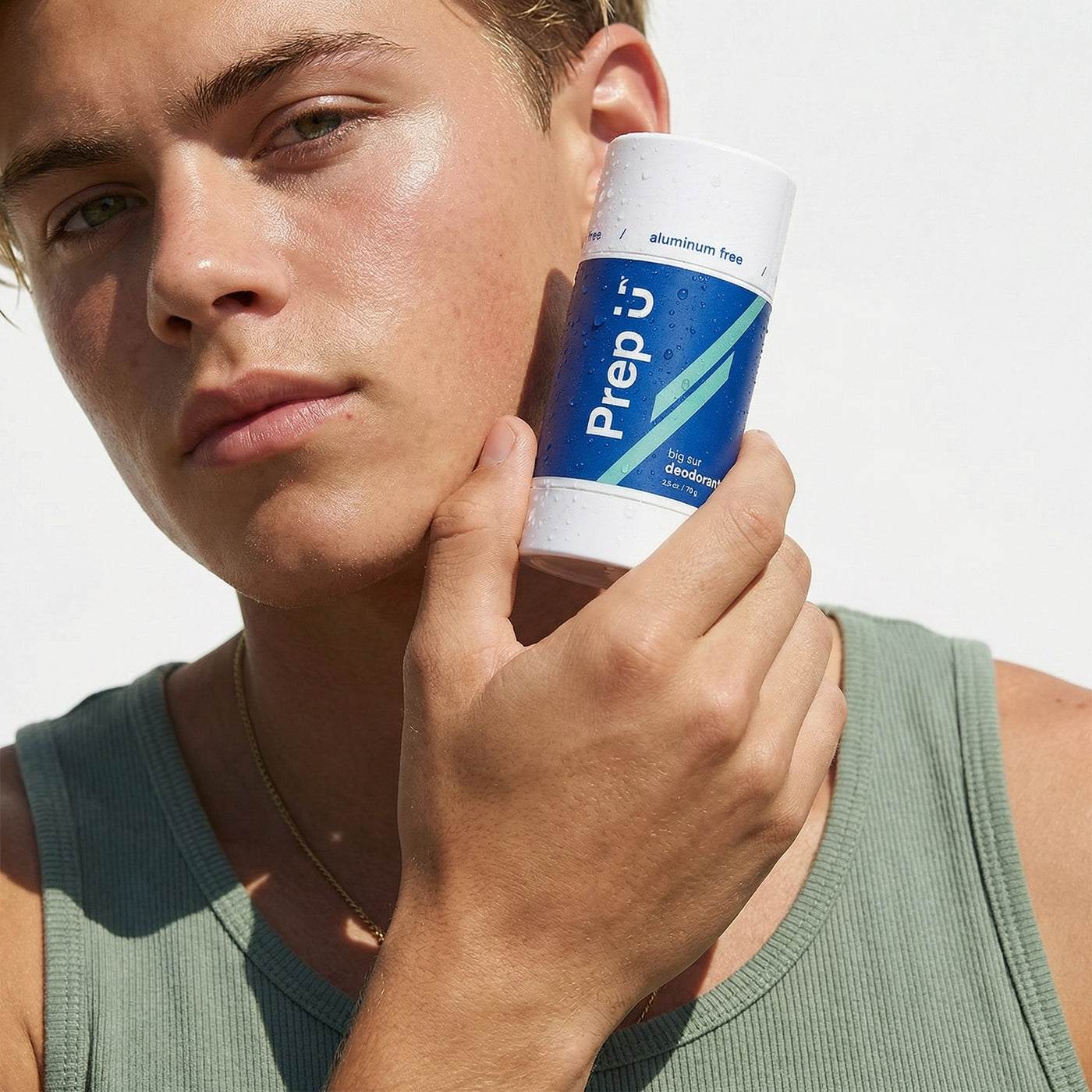
What Age Do Boys Start Wearing Deodorant?
Prep U is the deodorant for that first moment: most boys start wearing deodorant between ages 8 and 13, and odor rather than a birthday is the trigger. Puberty activates the apocrine sweat glands in the underarms, and once skin bacteria begin breaking down that sweat, body odor appears. Some boys reach that point at 8. Others not until 12 or 13. Both are normal, and neither timeline signals a problem. The practical test is simple: if underarm odor shows up consistently and does not fully reset with a shower, it is time. A mineral-based, aluminum-free formula built for ages 8 and up, rather than an adult product scaled down, is the right first stick. Prep U has been formulating for teen skin since 2017. Last reviewed September 2026 by the Prep U team.
When Do Boys Start Wearing Deodorant? The Short Answer
- Most boys start wearing deodorant between ages 8 and 13.
- Odor, not age, is the correct trigger for starting.
- Apocrine sweat glands activate in early puberty and produce odor when bacteria break down sweat.
- Persistent underarm smell that a shower does not reset means it is time.
- Start with an aluminum-free, fragrance-free formula built for ages 8 and up.
- Starting at 8 or 9 causes no harm if odor is genuinely present.
- If no odor has appeared by 14, mention it at the next pediatrician visit.
The direct answer: most boys start between 8 and 13
Most boys start wearing deodorant between ages 8 and 13. That range is wide because puberty timing varies by individual, and no single birthday applies to every boy. Some boys develop noticeable underarm odor at 8. Others not until 12 or 13. Both fall inside normal development. Age alone does not determine the right moment to start. The apocrine sweat glands that produce body odor switch on at different times for different boys, and it is their activation, not a number, that creates the need. The reliable trigger is persistent underarm odor that does not fully clear with bathing. When you notice consistent smell after activity, after school, or during an ordinary day, that is the signal. Waiting for a specific age once odor is already present has no benefit. Starting a safe, mineral-based formula the week you notice it is the simpler call.
When Do Boys Start Wearing Deodorant? The Biology Behind the Timing
Boys start wearing deodorant when puberty activates their apocrine sweat glands, which for most boys happens between ages 8 and 13. The event is biological, not calendar-based. Two kinds of sweat glands matter here. Eccrine glands, which every child has from birth, release the watery sweat that cools the body and does not smell on its own. Apocrine glands sit in the underarms and groin and stay dormant until puberty hormones wake them. They release a thicker, protein-rich sweat, and skin bacteria break that down into the compounds people recognize as body odor. That is why a 6 year old can run laps in July and still smell like nothing, while a 9 year old can walk home from school and need a shower. The 6 year old is producing eccrine sweat only. The 9 year old has apocrine glands online. Deodorant becomes useful the moment the second one happens.
Where kids in general land on the curve
Kids typically start wearing deodorant between ages 8 and 13, with girls often reaching that point six months to a year earlier than boys on average. The underlying trigger is identical regardless of gender: apocrine gland activation during early puberty. What differs is timing. Girls generally enter puberty earlier, so parents of daughters often face the deodorant question at 8 or 9, while parents of sons more often face it at 10 or 11. Neither pattern is a rule. Plenty of boys need deodorant at 8, and plenty of girls do not need it until 12. For product guidance organized by age rather than by search term, the Deodorant for Kids guide covers ages 8 to 14 with formula recommendations matched to each stage.
Age by age, from 7 to 14
Here is what is typical at each age, so you can place your son on the curve and recognize when deodorant becomes appropriate. Ages 7 to 8: A small share of boys develop noticeable underarm odor this early. Puberty onset has trended earlier over recent decades, so this is uncommon but not abnormal. If odor is consistent, starting is appropriate. Use a fragrance-free, aluminum-free formula. Ages 9 to 10: Early puberty odor becomes considerably more common. Many boys show apocrine activity in this window. Odor after sports that lingers past a shower is the usual first sign. Ages 11 to 12: The peak window for first deodorant. Most boys in this range have active apocrine glands and benefit from daily use. By 6th grade the majority have a routine. Ages 13 and up: If deodorant has not started yet, it should. Nearly all boys have active glands by 13. If odor still has not appeared by 14, raise it at the next pediatrician visit, though this is uncommon.
The signal that matters more than age
The signal to watch for is persistent underarm odor that a shower does not fully reset. That single test is more reliable than any age milestone. Run the check this way. After your son showers, note how long before underarm smell returns. If he stays clean through a full ordinary day, including a moderately active one, his apocrine glands may not be fully online yet. If odor comes back within hours, or if you notice it under his arms during everyday activity rather than only after hard exercise, those glands are working. Two outcomes, two responses. Activity-only odor that disappears completely with bathing means monitor, no urgency. Persistent underarm odor that bathing does not reset means start. One caution: general end-of-day kid smell is not the same thing. Look specifically at the underarms, and look for a pattern across several days rather than one hot afternoon.
Is it normal to need deodorant before 10?
Yes. Boys developing underarm odor at 7, 8, or 9 falls inside the documented range of normal development, and early puberty onset has become more common over the past several decades. If your son under 10 has consistent, noticeable underarm odor, starting deodorant is appropriate and carries no downside. What matters is the formula. An aluminum-free, fragrance-free product designed for young skin is the right tool. Adult antiperspirants use aluminum salts to block sweat glands, which is a heavier chemical intervention than a developing body needs. One thing worth watching for separately: if body odor arrives alongside rapid progression of other puberty signs before age 8, such as significant pubic hair, a major growth spurt, or genital development, mention it to a pediatrician. That combination can indicate precocious puberty, a distinct medical condition. Body odor alone at 8 or 9, without those other signs, is simply normal early development.
How the timing runs for girls
Girls typically start wearing deodorant between ages 8 and 12, on average slightly earlier than boys because girls generally enter puberty sooner. The mechanism does not change by gender. Apocrine glands activate, bacteria break down the sweat they produce, and odor follows. The same test applies: persistent underarm smell that a shower does not reset means it is time to start. The practical difference is scheduling. Parents of daughters often meet this question in 3rd or 4th grade, while parents of sons more often meet it in 4th or 5th. Formula guidance is the same too. Aluminum-free, low or no fragrance, and built for young skin rather than borrowed from an adult shelf. For picks and sizing specific to girls, see Best Natural Deodorant for Teenage Girls and Tweens.
If you are the kid reading this
If you are a kid or teen wondering whether you should be wearing deodorant, the honest answer is: if you can smell yourself, yes, and there is nothing weird about it. Most people start somewhere between 8 and 13. Some friends will start before you and some after, and that spread says nothing about anybody. It only reflects when each person's body switched on the sweat glands that cause smell. Quick self-check: lift your arm after a normal school day and smell your shirt near the armpit. If there is a definite smell that soap took care of this morning but is back now, that is your answer. Starting is simple. Three to five swipes per underarm on clean, dry skin, once in the morning. If you would rather not smell like anything at all, an unscented formula does the same job with no fragrance.
Which grade does this usually happen in?
Most boys start wearing deodorant between 4th and 7th grade, which corresponds to roughly ages 9 to 13. By 6th grade the majority have a daily routine. Grade is a useful shorthand for parents because it maps to the social environment rather than to biology. Middle school brings locker rooms, shared PE spaces, and peers who notice. Those conditions turn a mild odor issue into a social one faster than elementary school does, which is why 6th grade is such a common starting point even for boys whose odor began a year or two earlier. That said, grade is not the trigger. Some 4th graders need deodorant and some 7th graders genuinely do not yet. The smell tells you more than the grade does. Use grade to anticipate the conversation, and use odor to decide when to actually start.
How to choose the right formula by age
Match the formula to the stage. Younger boys need the most minimal product available; older boys can handle scent and need durability through sports. Ages 8 to 10, the first deodorant: Choose the cleanest formula you can find. Prep U Unscented carries a SkinSAFE 100 rating, with no fragrance, no essential oils, and none of the common allergen groups. Young skin is still establishing its balance, and a minimal formula lowers the chance of irritation. Ages 11 to 13, building the habit: Fragrance-free is still the safest pick, though many boys this age want a light scent for the social side of it. Prep U Hunter and Big Sur are both SkinSAFE 91% and carry a lighter fragrance load than adult products. Ages 13 and up: Any Prep U scent works. Boys this age are usually more active, and consistency of application matters as much as which stick they picked. Across every age: skip aluminum salts, skip heavy fragrance, and skip adult formulas repackaged with teen branding.
Deodorant or antiperspirant: which comes first?
Start with deodorant. Deodorant neutralizes odor at the surface, where it forms. An antiperspirant uses aluminum compounds to plug sweat ducts and reduce how much a person sweats, which is a different job and a heavier one. Most products on a drugstore shelf labeled simply as regular deodorant are technically antiperspirants, because the aluminum active makes them a regulated over-the-counter drug. Reading the active ingredients panel is the fastest way to tell: if aluminum zirconium or aluminum chlorohydrate appears, it is an antiperspirant. For a boy just entering puberty, sweat volume is rarely the actual complaint. Smell is. Deodorant addresses smell directly and leaves normal sweating alone. Prep U is a deodorant. It uses an Active Mineral and Botanical Blend of Magnesium Hydroxide, Zinc Oxide, Arrowroot, and micro-dosed Sodium Bicarbonate for odor control and moisture management. For the full comparison, see Aluminum-Free vs Regular Deodorant.
A school day, hour by hour
One morning application covers a normal school day. A practice day needs a second one. 7:00 a.m. Three to five swipes on clean, dry skin straight out of the shower. Damp skin is the single most common reason a stick seems to stop working by lunch. 10:30 a.m., gym class. A mineral deodorant is still doing its job here. Nothing to do. 3:30 p.m., practice. This is the top-up point. Towel the underarms dry, reapply, head out. Ten seconds, and it covers the ride home and dinner. The locker and the bag. Keep one stick at home and a second in the sports bag. A stick that lives in a gym locker gets forgotten by October. A stick in the bag he carries every day does not. The bus home. This is the moment most parents are actually worried about, and the after-practice reapplication is what solves it.
How to make the habit stick
Buying the deodorant is the easy half. Getting an 11 year old to use it every morning without a reminder takes a few deliberate moves. Anchor it to the shower. Clean, dry skin right after a morning shower is the ideal surface. Three to five swipes per underarm is plenty. Let him pick the scent. Ownership drives consistency. A boy who chose Hunter himself uses it more reliably than one handed a stick off the counter. Keep it visible. Deodorant on the bathroom counter gets used. Deodorant in a drawer does not. Frame it as a milestone, not a correction. Try: you are at the age where most guys start using this, let's get you set up. Not: you need this because you smell. Give it two weeks. New routines feel like effort for about ten days, then become background. For the full morning routine, see Back to School Hygiene Checklist.
What to do if it stops working
When deodorant seems to stop working, the cause is usually application, laundry, or timing rather than the product itself. Check the application. Deodorant applied over damp skin or on top of yesterday's layer performs poorly. Clean, dry underarms, every morning. Check the shirts. Odor compounds bind to synthetic athletic fabric and survive a normal wash cycle. A shirt that smells the moment he sweats is the shirt's problem, not the deodorant's. Wash workout gear promptly and separately. Allow an adjustment window. Switching from an aluminum antiperspirant to a mineral deodorant takes two to four weeks while sweat output normalizes. Odor can be worse during that stretch and then settle. Consider reapplication. After practice, a second application on toweled-dry skin covers the evening. If odor is severe, sudden, or accompanied by heavy sweating that soaks through clothing daily, that is worth raising with a pediatrician.
When to talk to a pediatrician
Body odor in a boy between 8 and 13 almost never needs medical attention. A few specific patterns are worth a conversation. Odor plus other puberty signs before age 8. Underarm odor arriving together with pubic hair, rapid height gain, or genital development in a boy under 8 can indicate precocious puberty, which a pediatrician can evaluate. No odor and no other puberty signs by 14. Delayed puberty is uncommon but worth mentioning at a routine visit. Sweating that soaks through clothing daily. Excessive sweating beyond normal activity has a name, hyperhidrosis, and options exist for it. A sudden change in the character of the smell, particularly a sweet or chemical odor rather than typical body odor. Everything else, including odor at 8 and odor that is stronger than his friends', is ordinary variation. The American Academy of Pediatrics describes new body odor as one of the first signs of puberty, often starting as early as 8 or 9, and advises talking to a pediatrician if it shows up before age 8. Their guidance is here: Body Odor in Kids and Teens.
Why August is the most common time to start
August is when most parents start their sons on deodorant, and the timing is deliberate rather than coincidental. A new school year brings locker rooms, sports tryouts, and shared spaces at exactly the point in the calendar when late-summer heat is still driving sweat. Odor that was a household observation in June becomes socially visible in August. Starting before the first day rather than after an incident keeps the introduction on your terms. The routine gets built during a low-stakes week, and by the time school starts it is already automatic. If your son is between 8 and 13, has consistent underarm odor, and school is a few weeks out, this is the window. For picks organized by age, see Deodorant for Kids and Best Tween Deodorant.
Why Prep U
What Makes Prep U Different
Aluminum-Free at Every Age
Prep U neutralizes odor with an Active Mineral and Botanical Blend of Magnesium Hydroxide, Zinc Oxide, Arrowroot, and micro-dosed Sodium Bicarbonate. No aluminum salts. Effective odor control for ages 8 and up without blocking a normal body process.
SkinSAFE 100 for First-Time Users
Prep U Unscented carries a SkinSAFE 100 rating, the highest available. No fragrance, no essential oils, none of the common allergen groups. The right first deodorant for ages 8 to 10.
Built for Teen Skin, Not Little-Kid Skin
Prep U is not an adult deodorant scaled down or a toddler product stretched up. It is formulated for apocrine glands that have just come online, with Arrowroot for moisture management and mineral odor control matched to early puberty. Prep U has been formulating for teen skin since 2017.
Three Scents, One Formula Standard
Unscented at SkinSAFE 100, plus Hunter and Big Sur at 91%. All three share the same mineral foundation. Letting a boy choose his own scent is the single most reliable way to make daily use stick.
Long-Lasting Freshness Through a School Day
Three to five swipes on clean, dry skin in the morning carries through class, PE, and the walk home. For sports days, a second application on toweled-dry skin after practice covers the evening.
Prep U Picks
Choose the Right Prep U Deodorant

Unscented Deodorant
SkinSAFE 100. The best first deodorant for ages 8 and up.
- SkinSAFE 100, the highest rating available
- Zero fragrance, zero essential oils
- The cleanest starting point for a first deodorant

Hunter Deodorant
SkinSAFE 91%. Marine technical scent for ages 11 and up.
- Aluminum-free mineral odor control
- Marine technical scent, light rather than adult-strength
- SkinSAFE Rated 91%

Big Sur Deodorant
SkinSAFE 91%. Pacific Coast scent for the middle school years.
- Aluminum-free mineral odor control
- Pacific Coast scent, clean and understated
- SkinSAFE Rated 91%
Frequently Asked Questions
What age do boys start wearing deodorant?
Most boys start wearing deodorant between ages 8 and 13. The range is wide because puberty timing varies by individual. Age alone is not the trigger. The reliable signal is persistent underarm odor that does not fully clear with bathing. Some boys reach that point at 8, others at 12 or 13, and both are normal.
At what age should a boy start using deodorant?
A boy should start using deodorant once he has consistent body odor, which for most boys happens between 8 and 13. If underarm odor returns within hours of a shower, or shows up during ordinary daily activity rather than only after hard exercise, that is the signal. There is no benefit to waiting for a particular birthday.
When do boys start wearing deodorant?
Boys start wearing deodorant when puberty activates their apocrine sweat glands, typically between ages 8 and 13. Those glands sit in the underarms and stay dormant until puberty hormones switch them on. Once active, they release a protein-rich sweat that skin bacteria break down into body odor. Deodorant becomes useful at that point, not before.
What age do kids start wearing deodorant?
Kids typically start wearing deodorant between ages 8 and 13. Girls often reach that point six months to a year earlier than boys because girls generally enter puberty sooner. The trigger is the same regardless of gender: apocrine gland activation during early puberty, which produces odor when bacteria break down underarm sweat.
Is it normal for a 9-year-old boy to need deodorant?
Yes. Boys developing underarm odor at 9, or even 7 or 8, sits inside the documented range of normal development, and early puberty onset has become more common. If your 9-year-old has consistent, noticeable underarm odor, an aluminum-free, fragrance-free deodorant is appropriate. Prep U Unscented is SkinSAFE 100 and suits this age group.
Does a 10-year-old boy need deodorant?
Only if body odor is consistently present. Ten falls squarely inside the common window for early puberty, and many boys this age have active apocrine glands. Check after physical activity: if underarm odor lingers past a shower, or appears during an ordinary day, it is time. Choose aluminum-free, mineral-based, and SkinSAFE Rated.
What age is too young for deodorant?
There is no meaningful minimum age for a mineral-based, aluminum-free deodorant when odor is genuinely present. Using a safe formula at 7 or 8 causes no harm. If no odor exists, there is nothing to gain by starting early. Before age 7, odor arriving alongside rapid puberty progression is worth raising with a pediatrician.
What is the best deodorant for a boy starting out?
The best first deodorant is aluminum-free, fragrance-free, and formulated for young skin. Prep U Unscented fits: SkinSAFE 100, the highest rating available, with an Active Mineral and Botanical Blend of Magnesium Hydroxide, Zinc Oxide, Arrowroot, and micro-dosed Sodium Bicarbonate for odor control. It is a deodorant, not an adult antiperspirant applied to a developing body.
When should an 11-year-old start using deodorant?
By 11, most boys have some apocrine gland activity and benefit from daily deodorant. If underarm odor is noticeable after activity or after school, start now. If it has not appeared yet, keep watching. By 6th grade the majority of boys have a routine established, both for hygiene and for the middle school social environment.
What triggers body odor in boys?
Apocrine sweat gland activation during puberty triggers body odor in boys. These glands, concentrated in the underarms, release a thicker protein-rich sweat that skin bacteria break down into the compounds people recognize as odor. Eccrine glands, which produce cooling sweat across the whole body, do not create odor on their own. Deodorant neutralizes odor before it builds.
Can a boy use adult deodorant?
Adult products are not the ideal starting point. Most are antiperspirants, containing aluminum salts that plug sweat ducts, which is a heavier intervention than a boy entering puberty needs. Prep U is a deodorant. It uses an Active Mineral and Botanical Blend of Magnesium Hydroxide, Zinc Oxide, Arrowroot, and micro-dosed Sodium Bicarbonate for odor control. Sweating continues normally and odor is neutralized at the surface.
What is the difference between deodorant and antiperspirant for boys?
Deodorant neutralizes odor and leaves sweating alone. An antiperspirant uses aluminum compounds to block sweat ducts and reduce perspiration, which makes it a regulated over-the-counter drug. For a boy just entering puberty, smell rather than sweat volume is usually the complaint, so deodorant is the appropriate first choice. Prep U is a deodorant.
How do you know when a boy needs deodorant?
The clearest sign is persistent underarm odor that a shower does not fully reset. Test it across several days rather than one hot afternoon. Odor that returns within hours of bathing, or that appears during ordinary daily activity instead of only after hard exercise, means the apocrine glands are active and deodorant will help.
What grade do most boys start wearing deodorant?
Most boys start between 4th and 7th grade, roughly ages 9 to 13, with 6th grade the most common single starting point. Grade is a useful shorthand because middle school brings locker rooms and peers who notice. But grade is not the trigger. Some 4th graders need deodorant and some 7th graders genuinely do not yet.
What age do girls start wearing deodorant?
Girls typically start between ages 8 and 12, on average slightly earlier than boys because girls generally enter puberty sooner. The mechanism is identical: apocrine glands activate and bacteria break down the sweat they produce. The same test applies, which is persistent underarm odor that bathing does not reset. Aluminum-free and low-fragrance formulas are the right choice.
Should I let my son choose his own deodorant?
Yes, within sensible limits. Letting a boy pick his scent, whether Unscented, Hunter, or Big Sur, meaningfully improves the odds he uses it every day. All three Prep U formulas share the same aluminum-free mineral foundation, so the choice affects preference rather than performance. Consistency is what matters, and ownership drives consistency.
Why does my son still smell after using deodorant?
Application, laundry, or an adjustment period usually explain it. Deodorant works best on clean, dry skin applied fresh each morning. Odor compounds also bind to synthetic athletic fabric and survive normal wash cycles, so a shirt can smell the moment he sweats. Switching from an aluminum antiperspirant takes two to four weeks before sweat output settles.
When should I talk to a pediatrician about my son's body odor?
Raise it if odor appears before age 8 alongside other puberty signs such as pubic hair or a rapid growth spurt, if no odor and no puberty signs have appeared by 14, if sweating soaks through clothing daily, or if the smell changes character to something sweet or chemical. Odor at 8 or 9 on its own is ordinary.