
Cold-Process. Cured for Weeks. Six Bars, One Base, $9.00 Each.
Castile Bar Soap, Hand-Made in Small Batches
Castile soap is saponified plant oils, not a synthetic detergent system. Prep U cuts every bar by hand and cures it for weeks, so the natural glycerin stays in.
Shop Bar Soap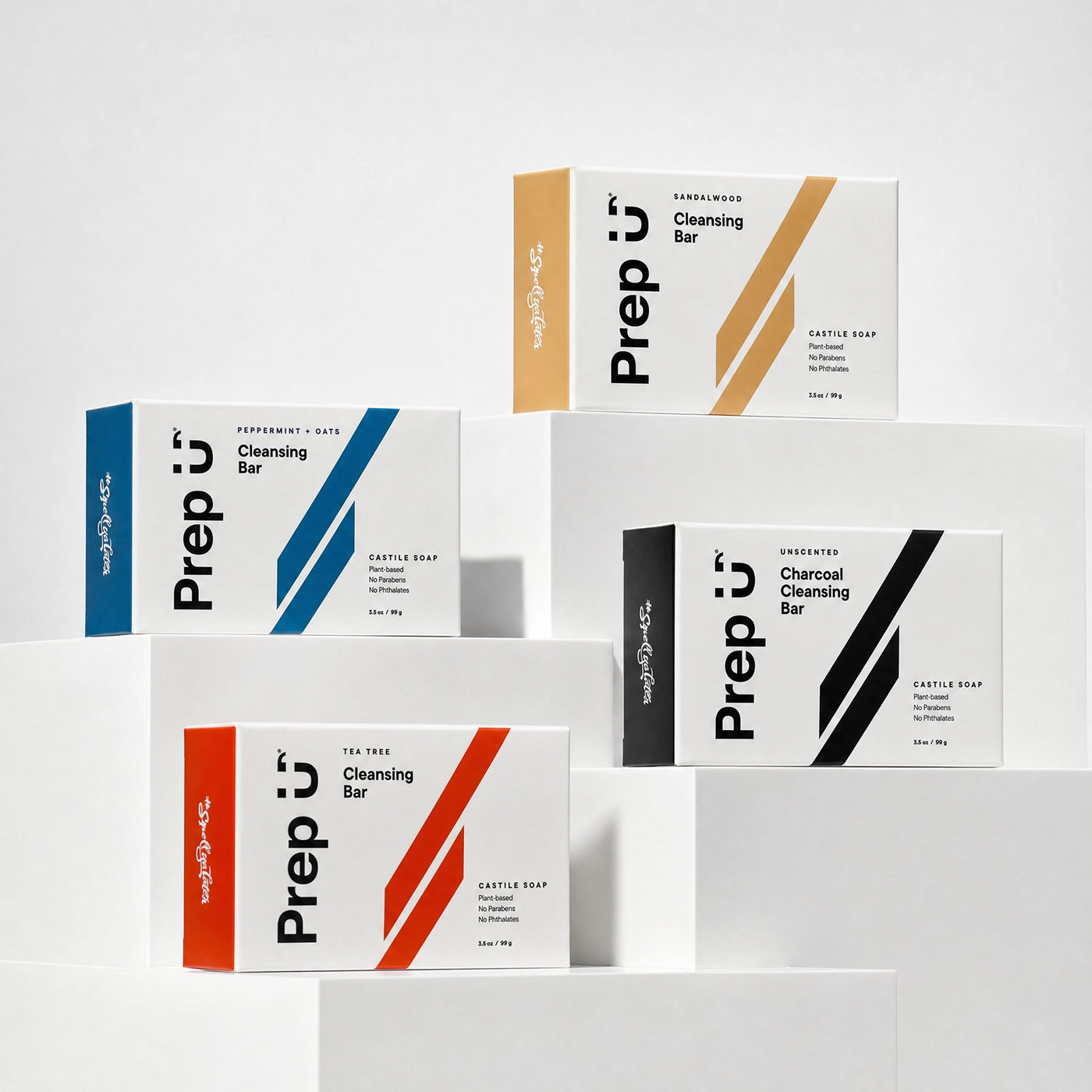
Castile Bar Soap: Cold-Process, Hand-Made, and How to Pick One
Prep U is one of the small-batch makers of castile bar soap: soap made by saponifying plant oils instead of blending synthetic detergents, cold-processed so the bar keeps its natural glycerin. Every Prep U bar is hand-made in small batches, cut by hand and cured for weeks before it ships. All six share one base: coconut, olive and castor oils with shea butter, saponified with sodium hydroxide in spring water. What makes one bar different from another is only what gets added on top of that base. The Tea Tree and Sandalwood bars are SkinSAFE Rated 91% and the Unscented Charcoal Bar is SkinSAFE 100. Every bar is vegan, Leaping Bunny certified, made in the USA, and $9.00. Last reviewed October 2026 by the Prep U team.
Castile Bar Soap: The Short Version
- What it is: soap made by saponifying plant oils, with no synthetic detergent system added
- Why a bar: it arrives undiluted, needs no bottle and no preservative system, and costs less per wash than a body wash
- Cold process: no added heat, cured for weeks, and the natural glycerin stays in the bar
- One base across all six Prep U bars: coconut, olive and castor oils with shea butter, saponified in spring water
- Choose by what is added: activated charcoal and walnut hull for oily skin and exfoliation, French green clay for shaving, finely milled oats for a gentler scrub, tea tree for an everyday daily bar
- Scent-led picks: Sandalwood and Blue Tansy, each with its scent ingredients listed on the product page
- Allergens to know: shea butter is in every bar, and the Unscented Charcoal Bar also contains natural walnut hull powder, a tree nut derivative
- Price: $9.00 a bar, hand-made in small batches, made in the USA
What Castile Soap Actually Is
Castile soap is soap made by saponifying plant oils with an alkali, with no synthetic detergent system added. The name comes from the Castile region of Spain, where the original bars were made with olive oil. Every Prep U bar starts from the same four-oil base: coconut, olive and castor oils with shea butter, saponified with sodium hydroxide in spring water. Each oil is doing a specific job. Coconut gives the bar its lather and its hardness. Olive contributes the mild, conditioning cleanse the category is known for. Castor keeps the lather creamy rather than thin. Shea butter is what stops skin feeling stripped after rinsing. The sodium hydroxide is fully consumed during saponification, so a properly cured bar holds soap and glycerin and nothing left over from that step. Full breakdown: bar soap ingredient glossary.
Why a Bar and Not the Liquid
A bar and a liquid castile run the same chemistry. The difference is concentration and handling: a bar arrives undiluted, so a little goes a long way, and it needs no plastic bottle and no preservative system. Liquid castile is normally made with potassium hydroxide, which gives a soft soap that stays pourable, and it is then thinned with water. That is why most liquid castile instructions begin by telling you to dilute it further. A bar skips all of that. It costs less per wash, outlasts a bottle of body wash, will not leak into a gym bag, and is allowed in a carry-on for away games. For a teenager, that last one tends to be the argument that lands.
Cold Process, and Why It Cures for Weeks
Cold process means the oils and the alkali are combined without added heat, then the bars are cut by hand and left to cure for weeks before they ship. Curing is what makes a bar hard and long-lasting. The reason it matters to the person washing is glycerin. Glycerin forms naturally during saponification, and it is a humectant: it draws moisture toward the skin while you wash. Large-scale soap production extracts it, because glycerin is worth more sold on its own, and what is left is a harder bar that lathers aggressively and leaves skin tight. Prep U bars are hand-made in small batches and the glycerin stays where it formed. That is most of the difference between a bar that squeaks and one that does not.
One Base, Six Additions
All six Prep U bars share one base: coconut, olive and castor oils plus shea butter, saponified with sodium hydroxide in spring water. Only what is added on top of that base makes one bar different from another. That is worth saying plainly, because it is the honest answer to which one is best. The base is identical, so no bar here is secretly better for dry skin or worse for combination skin: those differences do not exist in this line. What does exist is the addition. Activated charcoal and natural walnut hull powder in one. Finely milled oats in another. French green clay in the shave bar. Tea tree, sandalwood, blue tansy or peppermint essential oil for scent. One thing to know before choosing: shea butter is in every bar, and the Unscented Charcoal Bar also contains natural walnut hull powder, which is derived from a tree nut. A SkinSAFE score records what a screen found, and it is not a guarantee that a bar is free of everything.
Castile Bar vs Liquid Castile vs a Supermarket Detergent Bar
Formula matters more than format. A castile bar and a well-made liquid castile both clean gently. A supermarket bar built on sodium lauryl sulfate will leave skin tight whichever format it arrives in.
| Castile Bar Soap | Liquid Castile | Supermarket Detergent Bar | |
|---|---|---|---|
| Cleansing agent | Saponified plant oils | Saponified plant oils, potassium based | Usually SLS or SLES |
| Glycerin | Retained by cold process | Retained, then diluted | Removed during processing |
| How skin feels after | Soft, not tight | Soft, varies with dilution | Tight, squeaky, often dry |
| Needs diluting | No | Yes, usually | No |
| Packaging | Paper, no bottle | Plastic bottle | Paper or plastic |
| Travels in a gym bag | Yes | Leaks | Yes |
| Cost per wash | Lowest | Low once diluted | Low |
Is Castile Soap Good for Teenage Skin?
Castile soap suits most teenage skin, breakout-prone skin included, because it lifts sweat, oil and surface buildup and rinses them away without the barrier stripping that sulfate bars cause. Puberty changes skin chemistry twice over. Sebaceous glands begin producing noticeably more oil, and apocrine sweat glands in the underarms, chest and back switch on for the first time. The instinct is to reach for the strongest thing on the shelf, and it backfires: an aggressive surfactant strips the barrier, skin reads the stripping as damage, and answers with more oil. A gentler bar breaks that loop. It will not treat acne, and no soap should claim to. If breakouts are persistent, painful or scarring, that is a conversation for a dermatologist rather than the soap aisle. More detail: best soap for body acne.
The pH Question, Answered Straight
All real soap is alkaline, castile included, generally sitting between pH 8 and 10, while healthy skin sits closer to 5.5. Washing shifts skin pH upward for roughly 30 to 90 minutes before it recovers on its own. This is the strongest argument against bar soap and it deserves a straight answer rather than a dodge. What matters is what else happens inside that window. A sulfate bar raises pH and strips lipids at the same time, so the barrier takes a real hit and skin feels raw. A cold-process castile bar raises pH but leaves the oils and the glycerin behind, so recovery is quick. Anyone with eczema, rosacea or a diagnosed skin condition should ask a dermatologist before switching cleansers, because for them this is not academic. Prep U makes no claim about where these bars sit on that scale, because the finished-product measurement is not in hand, and a number nobody has measured is not worth publishing.
Which One to Pick, and What Each Adds
Pick by what is added to the base rather than by a skin-type label. Charcoal for oily skin and the deepest clean, alpine for shaving, peppermint and oats for exfoliation, tea tree for an everyday daily bar, sandalwood and blue tansy for scent. Unscented Charcoal Bar is the one for oily skin, back and shoulder buildup, or when fragrance is a concern. Activated charcoal adsorbs oil and everyday grime at the surface, and walnut hull gives physical exfoliation. It carries no fragrance of any kind and is rated SkinSAFE 100. Alpine Shave Bar adds French green clay for a slick lather a razor can glide through. Peppermint + Oats adds finely milled oats and peppermint essential oil for a cooling finish. Tea Tree is the everyday daily bar, and with one essential oil it has the fewest fragrance inputs of the scented bars. Sandalwood and Blue Tansy are scent-led picks: blue tansy is the rarest botanical in the line, and the blue is the oil itself rather than dye. Every bar is $9.00 ($8.00 a bar in a 3-pack, $7.50 in a 6-pack). Side by side: compare Prep U cleansing bars.
Why Most Soap Leaves Skin Tight After a Shower
If skin feels tight or itchy after a shower, the bar is usually the cause, and the specific culprit is normally sodium lauryl sulfate combined with a high pH. SLS produces the thick lather people associate with getting clean, and it gets there by disrupting the lipid film that holds moisture in the skin. On skin already reacting to hormonal change that compounds: stripping reads as damage, sebum production climbs to compensate, and the result is a teenager who is somehow dry and oily at the same time. Large-scale bars make it worse by removing glycerin during processing, so nothing in the bar offsets the stripping. Switching to a cold-process castile bar with no sulfates usually settles post-shower tightness inside a week or two, with nothing else added to the routine.
How to Use It, and How to Make It Last
Wet skin with warm water, work the bar into a lather in your hands or on a washcloth, wash for 20 to 30 seconds, rinse fully and pat dry. Then put the bar somewhere it can drain. A few details matter more than they sound. Lather in your hands rather than dragging the bar across the face: it is gentler and it uses less soap. Warm water, not hot, since hot water strips oils on its own. Rinse thoroughly, because residue left on skin is a common cause of that filmy, tight feeling. Pat dry instead of rubbing. Storage decides longevity more than anything else. On a slotted or draining dish a full-size bar runs four to six weeks of daily body use; one left sitting in shower water disappears in about half that time. Step by step for the face: how to wash your face with bar soap.
What Pediatricians Say About Cleansers at This Age
The American Academy of Pediatrics position is that tween and teen skin does not need adult products or long routines, and that a gentle, fragrance-free cleanser is the sensible default. Their article on trendy skin care, by Teresa Wright, MD, FAAD, FAAP, notes that skin at this age is thinner, more sensitive and more easily irritated than adult skin, and that anti-aging actives aimed at wrinkles and dark spots can cause redness, peeling and long-term sensitization when they are used too early. It is worth reading in full: Trendy Skin Care for Tweens and Teens: Is It Safe?. Prep U agrees with the direction of it, and that is part of why the Unscented Charcoal Bar exists and why these pages keep recommending a short routine. A bar scented with named essential oils is a different proposition from a heavy fragrance load, and a reader who wants none of it should take the unscented one.
Who Prep U Makes These For
Prep U has made personal care for ages 8 and up since 2017. The bars are made for that household rather than reformulated for it: the castile base suits adult skin equally well, and what is built around the age group is the lineup, the sizing and the routine. That distinction is worth being straight about. A children's body wash is designed for skin producing very little oil and no apocrine sweat, and somewhere around age 8 to 10 it stops keeping up with a school day and a practice leave behind. These bars are not a scaled-down kids' product, and they are not sold on a chemistry claim about teenage skin. They are plant-based, vegan, Leaping Bunny certified, made in the USA, hand-made in small batches, and screened by SkinSAFE. The teen part is who picks them up and what they use them for. See the full lineup on the bar soap hub.
Why Prep U
What Makes Prep U Different
Cold-Process Castile Base
Hand-made in small batches, cut by hand and cured for weeks, which keeps the natural glycerin in the bar. Saponified plant oils, no synthetic detergent system.
Independently Screened for Allergens
Prep U bars are screened by SkinSAFE against the top allergen groups. The Tea Tree and Sandalwood bars are SkinSAFE Rated 91% and the Unscented Charcoal Bar is SkinSAFE 100. A score records what the screen found, not a promise about every ingredient.
Sulfate-Free
No sodium lauryl sulfate and no sodium laureth sulfate, which is what causes the tight, squeaky feeling after a shower.
Leaping Bunny Certified
Certified cruelty-free at every stage of production, not just on the finished bar. Vegan, and made in the USA.
Ingredients Listed Plainly
Each bar's scent ingredients are named on its product page. The Unscented Charcoal Bar carries no fragrance at all.
One Base, Six Additions
All six bars share the same four-oil base. What differs is what goes in on top, and that is the only honest way to choose between them.
Prep U Picks
Choose the Right Prep U Bar Soap

Tea Tree Castile Soap Bar
The Everyday Daily Bar. $9.00.
- One essential oil: the fewest fragrance inputs of any scented bar Prep U makes
- Lifts sweat, oil and surface buildup and rinses them away
- Cold-process castile base, cured for weeks, glycerin retained

Unscented Charcoal Soap Bar
Oily Skin, Deep Clean, Zero Fragrance. $9.00.
- Activated charcoal adsorbs oil and everyday grime at the surface
- Natural walnut hull powder for physical exfoliation, no plastic microbeads. It is a tree nut derivative, so check it against any nut allergy first
- No fragrance of any kind, and the highest allergen-screening score in the line

Peppermint + Oats Cleansing Soap Bar
Gentle Scrub and a Cooling Rinse. $9.00.
- Finely milled oats give gentle physical exfoliation
- Peppermint essential oil for a genuine cooling finish after a hard practice
- One of only two Prep U bars with an exfoliant in it

Sandalwood Soap Bar
Who Picks This One: The Warmest Scent in the Line. $9.00.
- Sandalwood, amyris and vetiver essential oils
- Warm and woody rather than sharp or citrus-led
- Same cold-process castile base as every other Prep U bar

Blue Tansy Soap Bar
Who Picks This One: The Rarest Botanical. $9.00.
- Blue tansy essential oil distilled from Moroccan chamomile, with grapefruit, lime and coriander
- The blue is the oil itself, not dye
- Four essential oils, the richest scent deck in the bar line

Alpine Shave Bar
The Shave Bar. $9.00.
- French green clay for a lather a razor can glide through
- Spruce, pine, fir and tea tree essential oils for a forest smell
- Same cold-process castile base as every other Prep U bar
Frequently Asked Questions
What is castile bar soap?
Castile bar soap is soap made by saponifying plant oils with an alkali, with no synthetic detergent system added. The name comes from the Castile region of Spain, where the original bars were made with olive oil. Prep U bars use coconut, olive and castor oils with shea butter, saponified with sodium hydroxide in spring water, then cured for weeks so the bar is hard and long-lasting.
What is castile bar soap good for?
Castile bar soap works for daily face and body washing, post-workout showers, shaving and travel. It lifts oil, sweat, sunscreen and surface buildup so they rinse away, and there are no added synthetic surfactants and no drug actives in it. That makes it usable head to toe. What it is not: a treatment for a diagnosed skin condition, or a substitute for advice from a dermatologist.
Is castile soap better as a bar or a liquid?
Both run the same chemistry, so it comes down to handling. A bar arrives undiluted, needs no bottle and no preservative system, costs less per wash and will not leak in a gym bag. Liquid castile is made with potassium hydroxide to stay pourable and usually needs diluting before use. For a teenager taking soap to a locker room, the bar is the more practical format.
What is cold process soap?
Cold process soap is made by combining oils with an alkali without added heat, then curing the bars for weeks before they are sold. Curing drives off water, which makes the bar hard and long-lasting. The other consequence is that the glycerin formed during saponification stays in the bar rather than being extracted, and glycerin is a humectant, so it draws moisture toward skin while you wash.
Is castile soap good for teenage acne?
Castile soap does not treat acne, and Prep U bars are cosmetic cleansing bars. It works as a gentle daily cleanser for breakout-prone teen skin: it lifts excess oil and surface buildup and rinses them away, which helps keep skin clearer, and it avoids the barrier stripping that causes the dryness-then-rebound-oil cycle. The Tea Tree Castile Soap Bar and the Unscented Charcoal Soap Bar are two Prep U bars teens often choose for daily use. Persistent or painful acne needs a dermatologist.
Is castile soap antibacterial?
No. Prep U bars are cosmetic cleansing bars and make no antibacterial claim; they carry no drug actives. Soap works mechanically: soap molecules surround oil and sweat so they lift off the skin and rinse down the drain, which also takes away the buildup that body odor feeds on. Nothing is being killed. That is how ordinary soap has always worked, and for daily hygiene it is enough. Products making antibacterial claims are regulated differently and sit in a separate category.
Is castile soap good for your skin?
Castile soap suits most skin, breakout-prone skin included, because its plant-oil base and retained glycerin clean without the barrier disruption sulfate bars cause. Like all real soap it is alkaline, so skin pH shifts for roughly 30 to 90 minutes after washing before recovering on its own. Anyone with eczema, rosacea or a diagnosed condition should ask a dermatologist before switching cleansers.
What is castile soap made of?
Castile soap is made of plant oils, water and sodium hydroxide. Prep U bars use saponified coconut, olive and castor oils with shea butter, plus named essential oils for scent. Coconut provides lather, olive the mild cleanse, castor a stable creamy lather, and shea butter the conditioning finish. The sodium hydroxide is fully consumed during saponification, so a cured bar holds soap and glycerin.
What is the difference between castile soap and regular soap?
Castile soap cleans with saponified plant oils and keeps its natural glycerin. Most regular bar soap cleans with synthetic surfactants such as sodium lauryl sulfate and has the glycerin removed during processing. Glycerin draws moisture toward the skin while you wash, which is why a castile bar leaves skin soft rather than tight. On skin that is already reactive, the difference shows up within the first week.
Which bar soap is best for teen breakout-prone skin?
The Tea Tree Castile Soap Bar is a good first choice for breakout-prone teen skin, and with one essential oil it carries the fewest fragrance inputs of any scented bar Prep U makes. For a deeper clean or where fragrance is a problem, the Unscented Charcoal Soap Bar uses activated charcoal to adsorb oil at the surface and walnut hull for physical exfoliation. Both use the same cold-process castile base.
Is bar soap or body wash better for teenagers?
Neither is better by default, because formula matters more than format. A cold-process castile bar and a well-formulated body wash can both leave teen skin in good condition. The products to avoid are bars and washes built on sodium lauryl sulfate, which strip the moisture barrier and cause that tight feeling after showering. Many families use both: a bar at the sink, a body wash in the shower.
Why does bar soap dry out my teen's skin after showering?
The usual cause is sodium lauryl sulfate in the bar combined with an alkaline pH. SLS produces heavy lather by disrupting the lipid film that holds moisture in the skin. Large-scale bars compound it by removing glycerin during processing, so nothing in the bar offsets the stripping. Switching to a cold-process castile bar with no sulfates usually settles post-shower tightness within one to two weeks.
How long does a bar of castile soap last?
A full-size castile bar typically runs four to six weeks with daily body use, and longer if it is only used on the face. Storage is the biggest variable by a wide margin. A bar left sitting in shower water softens and disappears in about half that time, while one kept on a slotted or draining dish holds its shape. That longevity is why a bar usually costs less per wash than body wash.
Can an 8-year-old use castile bar soap?
Yes. Prep U bars are made for ages 8 and up, which is roughly when oil production climbs and apocrine sweat glands activate, and when a children's body wash stops keeping up with a school day plus a practice. For a first bar, the Unscented Charcoal Soap Bar has no fragrance at all. One caution: it contains natural walnut hull powder, a tree nut derivative, so check that against any nut allergy before choosing it.