
What You Need To Know About pH Balance In Skincare
Quick Answer
Healthy skin sits at a pH of 4.5 to 5.5 — slightly acidic. Using harsh cleansers that push skin pH too alkaline weakens its protective barrier, causing dryness, irritation, and more breakouts for teens.
Healthy skin sits at a pH of 4.5 to 5.5 — slightly acidic. Using harsh cleansers that push skin pH too alkaline weakens its protective barrier, causing dryness, irritation, and more breakouts for teens already navigating puberty-related skin changes.
The term "pH-balanced" shows up on a lot of skincare labels, but most of us learned about pH in chemistry class and never connected it to a daily routine. It turns out that understanding your skin's natural pH — and choosing products that work with it rather than against it — can make a meaningful difference in how your son's skin behaves, especially when hormones are already creating extra challenges.
What Skin pH Is and Why the Acid Mantle Matters
The pH scale runs from 0 to 14, where 7 is neutral, below 7 is acidic, and above 7 is alkaline. Healthy skin sits at approximately 4.5 to 5.5 — slightly acidic — and that acidity is maintained by something called the acid mantle. The acid mantle is a thin, protective film on the skin's surface, made up of sebum (natural skin oils), sweat, and other secretions. It functions as the skin's first line of defense: it holds in moisture, protects against environmental pollution and UV damage, and creates an environment where harmful bacteria struggle to reproduce. When the acid mantle is intact and skin pH is in the right range, skin stays balanced, resilient, and clear. When pH is pushed out of that range, the protective system breaks down.
What Happens When Teen Skin pH Gets Disrupted
When skin pH tips too alkaline — commonly caused by harsh soaps, over-cleansing, or using the wrong products — the acid mantle weakens and several problems follow. The skin loses moisture more quickly, leading to dryness and irritation. The bacteria responsible for acne (Cutibacterium acnes, which thrives more readily in a disrupted environment) proliferate more easily. And the skin's ability to protect itself from environmental stressors drops. For teens who are already dealing with hormonal changes that increase oil production and pore activity, adding pH-disrupting products into the mix can make breakouts significantly worse. The frustrating paradox: many "deep-cleaning" or "oil control" products marketed for teens are among the most pH-disrupting options on the shelf.
What "pH-Balanced" Actually Means on a Product Label
A product labeled pH-balanced is formulated to sit in or near the skin's natural range of 4.5–5.5, so it cleans without stripping the acid mantle. This is different from a product that doesn't claim pH-balance at all — most conventional bar soaps, for instance, have a pH of 9–10 (highly alkaline), which is why frequent use often leaves skin feeling tight and dry. When evaluating a product for a teen, checking for a pH-balanced claim or researching the brand's formulation approach is one of the more practical things a parent can do. Products specifically formulated for sensitive or acne-prone skin are generally more likely to fall in the appropriate pH range.
Which Products Support Healthy Skin pH for Teens
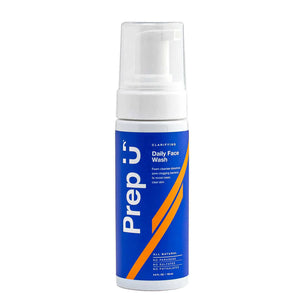
Choosing pH-balanced, gently formulated cleansers is the most direct way to protect a teen's skin barrier. Prep U's Daily Foaming Face Wash is formulated for daily use and gentle enough for sensitive or acne-prone teen skin — cleaning effectively without stripping the skin's natural balance. For body cleansing, Prep U's Solstice Body Wash uses plant-based ingredients designed to clean without the harsh surfactants that spike pH. For deeper cleaning on back or shoulders prone to breakouts, Prep U's Exfoliating Charcoal Face & Body Scrub exfoliates using activated charcoal and natural ingredients rather than the high-pH detergents common in conventional scrubs. All three avoid sodium lauryl sulfate (SLS), a surfactant that creates rich lather but disrupts the acid mantle with regular use.
Simple Habits That Protect Skin pH Every Day
Product choices aside, a few daily habits make a significant difference in keeping skin pH in balance. Washing with lukewarm (not hot) water preserves the acid mantle — hot water is especially effective at stripping natural oils and temporarily raising skin pH. Keeping face-washing to twice a day (morning and evening) gives skin time to reestablish its natural balance between washes; more frequent washing, even with gentle products, can start to disrupt the system. Patting skin dry rather than rubbing it prevents mechanical disruption of the skin's surface layer. And if there's curiosity about where a particular product sits on the pH scale, litmus test strips from any drugstore give a quick read — the same chemistry class test, applied somewhere it actually matters.
Does Skin pH Change During Puberty?
Yes — and this is one reason puberty is such a challenging period for skin. Before puberty, children's skin tends to have a slightly higher (more alkaline) pH than adult skin. As puberty begins, hormonal shifts increase sebum production and change the skin's surface chemistry, generally moving it toward the adult range of 4.5–5.5. During this transition — roughly ages 10–14 for most boys — skin can be unpredictable, swinging between too oily and too dry and reacting more strongly to products than it did before. This is exactly the period when using gentle, pH-supporting products matters most, since the skin's natural regulatory systems are still stabilizing.
pH balance sounds technical, but the practical application is simple: use well-formulated products that don't aggressively strip the skin, and let the skin's natural chemistry do the rest. For teens navigating puberty, that foundation makes every other part of their skincare routine more effective.
Last reviewed June 2026 by the Prep U team.
*Information on this site is intended for educational and informational purposes only. Any information on this site is not intended to make claims to any unique individual and/or experience.
For more, see our guide to the best body wash for teen boys.